Mail call just became the best hour of the month.
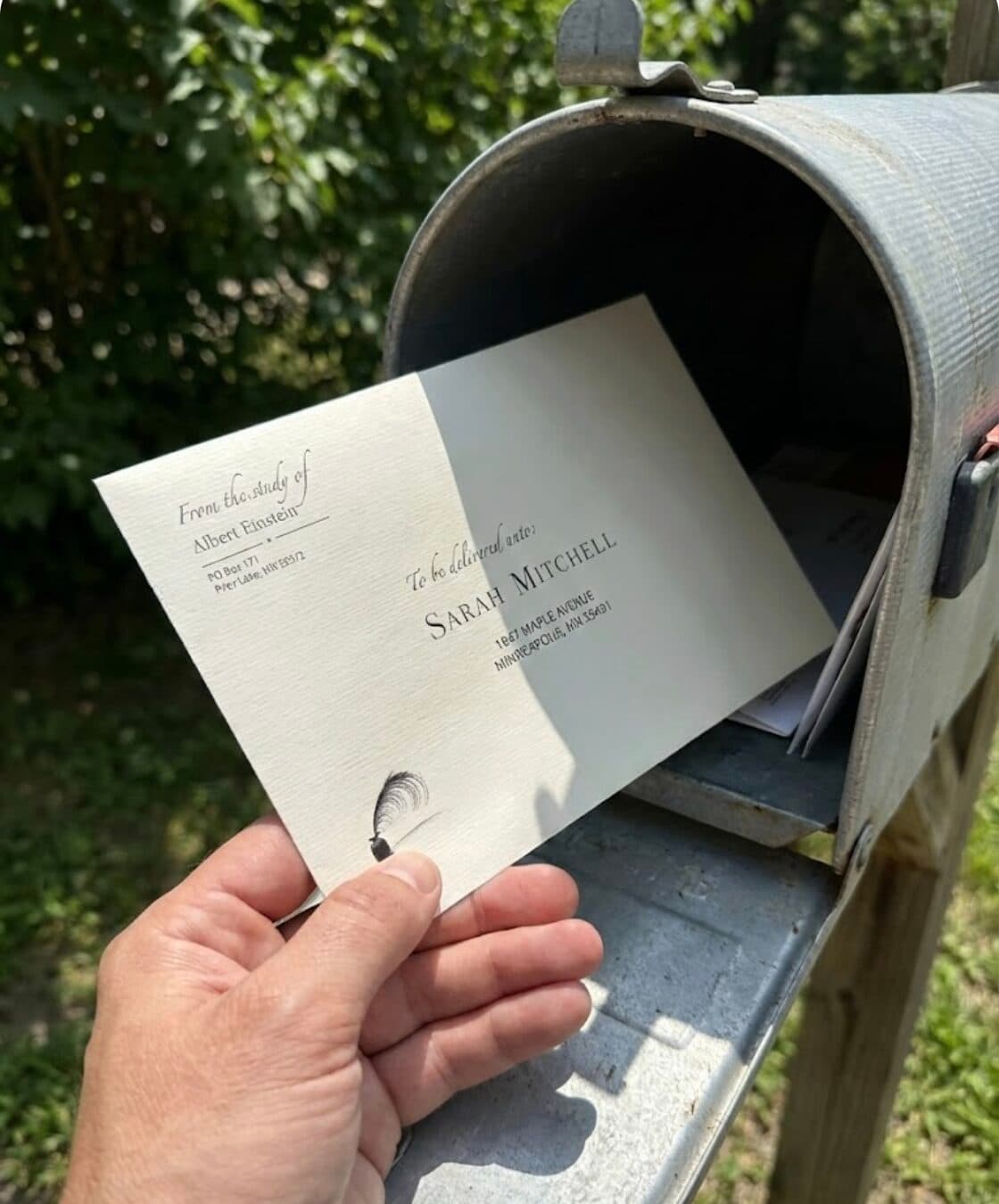
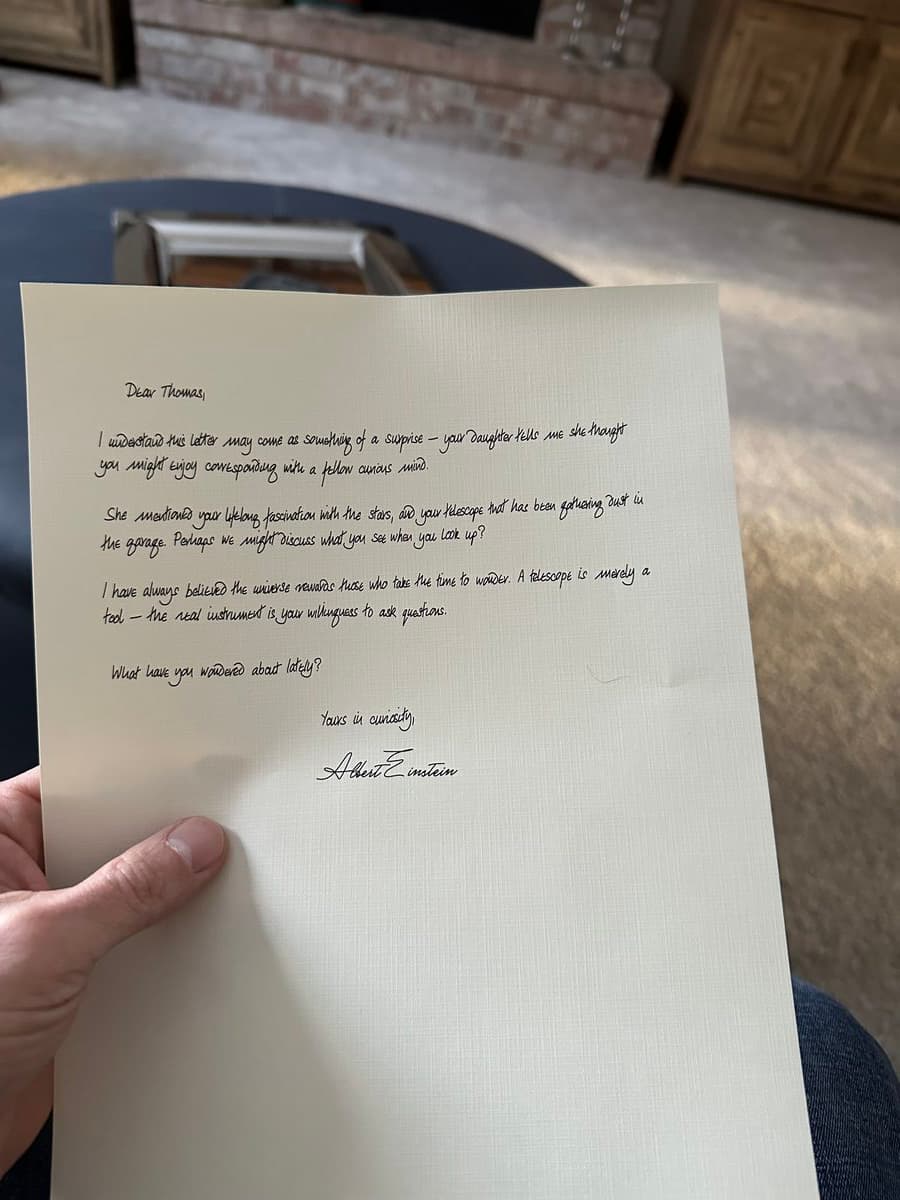
Every resident gets a sealed envelope with their name on it, written in real ink by their own pen pal from history. Einstein. Jane Austen. Teddy Roosevelt. The envelopes open together, and the room starts talking.
Five residents. One month. No card, no contract.
Or ask us to mail a sample letter addressed to you, so you can hold one first.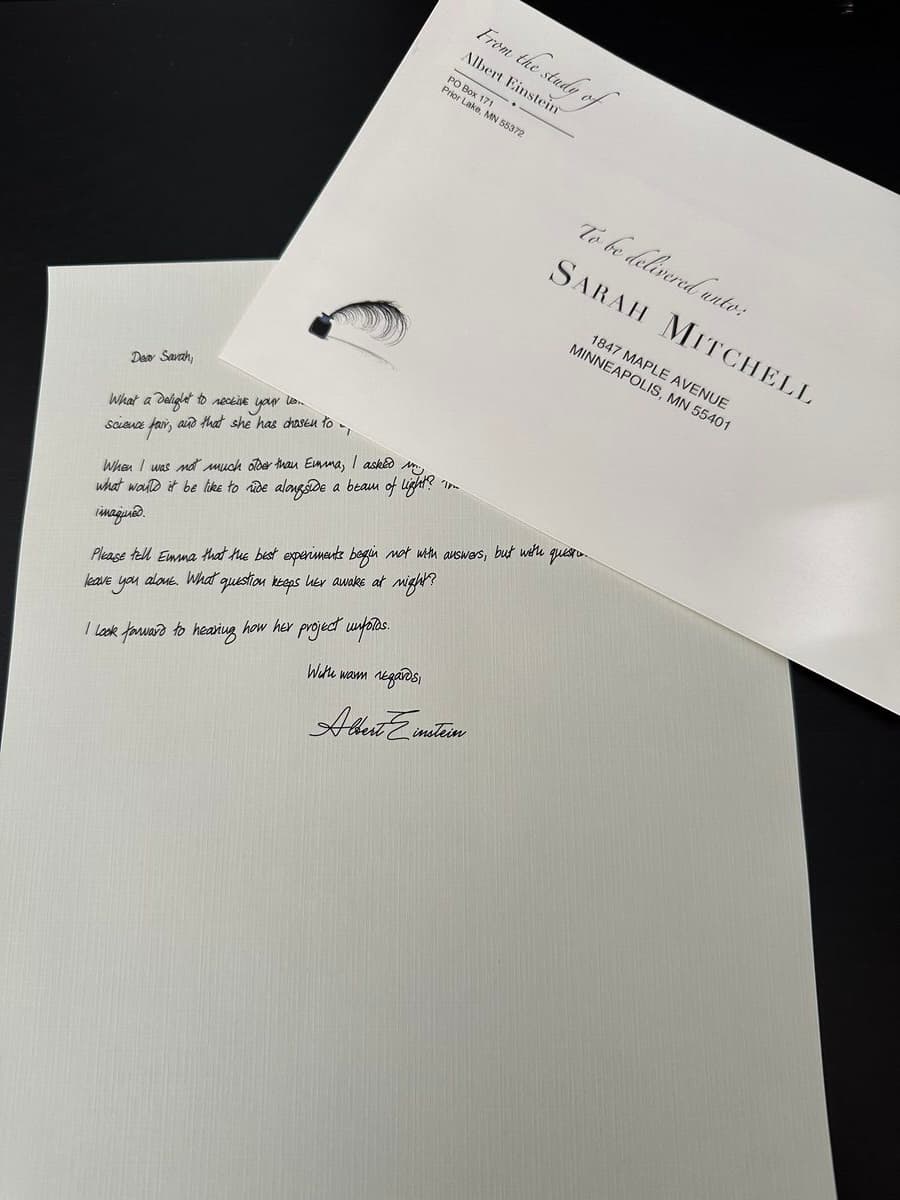
Once a month, one package lands on your desk.
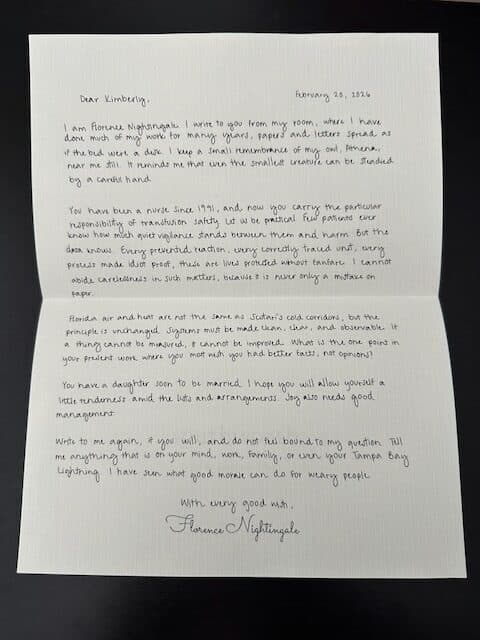
The words are composed in each figure's documented voice and personally reviewed; the ink, the paper, and the mail are completely real.
I reply to every request personally, within one business day.
Mark, Historical Pen Pals
How It Works
You run one event. We do the rest.
Tell us about each resident.
A two-minute form per resident, filled out by family or staff. First name, hometown, what they did for a living, what they love. Pick their pen pal from more than 45 figures, or write "surprise them." That's the whole setup.
The Pen Pal Day box arrives.
Once a month, one package lands on your desk. Inside: a sealed, individually addressed envelope for every enrolled resident, plus everything you need to run mail call. No envelopes straggling in a day late. No resident's letter missing.
Hand out the mail.
Residents open their letters together. Those who want to write back can, on the reply sheet or any paper they like. A staff member photographs the reply with a phone. Ten seconds per letter, and you're done.
The answers come back.
Every reply gets a personal answer in the regular mail within about a week. Residents who write often get extra mail days between events. Residents who never write still get their letter every month, no matter what.
The Monthly Event
One box. One day. Everyone included.
We could mail each resident's letter separately. We don't, on purpose.
Once a month
Every enrolled resident's letter ships together as a single package, addressed to you. That's what makes Pen Pal Day possible: every envelope arrives the same day, so the whole community opens their mail in the same room, at the same moment. Dorothy hears from Einstein. Frank hears from Mark Twain. Then Dorothy wants to know what Twain said.
In between
Every reply gets a personal answer in the regular mail within about a week. Residents who write often get extra mail days between events.
a calendar anchor you can plan around
a read-aloud table
the photo that goes in your family newsletter
Residents who wrote back recently get their answer in this letter. Residents who never write get a letter anyway, because their pen pal simply keeps the conversation going.
The ceremony is identical for everyone. The mail is personal to each.
Every Letter Is Unique
Personal to each resident's own story
Each pen pal writes about the resident's own past: the hometown, the working years, the era they know best.
"Dear Sarah,
I was moved to learn you've been thinking about changing careers at forty. When I left my position as emperor each night to write philosophy by candlelight, many thought it foolish. But the soul knows when it is time to grow. Tell me, what is it you dream of becoming?"
Marcus Aurelius
in correspondence
"Dear James,
Your daughter sounds like quite the curious mind, building circuits at twelve! When I was her age, I dismantled every clock in my father's shop just to see how the gears whispered to each other. Does she take things apart too, or does she prefer to build from nothing?"
Nikola Tesla
in correspondence
"My dear Elena,
You write that you feel invisible in meetings, that your ideas seem to evaporate before they reach anyone's ears. I know this silence intimately. In Paris, I was told radium was impossible. I simply stopped asking for permission. What would you attempt if no one could tell you no?"
Marie Curie
in correspondence
✦ Written in real ink. Mailed to your door. ✦
Why Letters
Built on the principles of reminiscence.
Activity professionals were running reminiscence programs long before anyone studied them. You already know what happens when a resident gets asked the right question about 1962: the posture changes, the details pour out, the table leans in.
Our letters are built to do exactly that, one resident at a time. Each pen pal writes about the resident's own past: the hometown, the working years, the era they know best. The letter is the prompt, and the reply is the activity.
Looking back on a life well lived is more than pleasant. Across more than a hundred controlled studies, structured reminiscence activities have been associated with better mood and a stronger sense of meaning in older adults. Every Historical Pen Pals letter is written to spark exactly that kind of remembering, with questions drawn from the resident's own story.
Pinquart and Forstmeier, Aging and Mental Health, 2012
A major Cochrane review of 22 randomized trials linked structured reminiscence sessions to small improvements in mood, communication, and quality of life for some participants, especially in care homes. Effects in research were modest and varied person to person; Historical Pen Pals is a recreational activity inspired by that tradition, not a therapy.
Woods et al., Cochrane Review, 2018
That finding will not surprise anyone who has run a memory box session. What a letter adds is anticipation. The conversation doesn't end when the hour does; another envelope is always on its way.
The National Institute on Aging encourages older adults to stay connected: regular contact with others, shared interests, old hobbies revisited. A personal letter exchange fits all three, in an unhurried, screen-free format that suits residents who find phones and tablets tiring.
National Institute on Aging, via NIH MedlinePlus Magazine
There is also the simple matter of being written to by name. A letter is one of the few things a resident receives that was made for them and nobody else.
Roughly one in four Americans over 65 is socially isolated, and the National Academies (2020) rank isolation alongside smoking and high blood pressure as a risk factor for early death. Connection is not a luxury in later life. A pen pal program is one simple, steady way to add a moment of genuine connection to a resident's week.
National Academies of Sciences, Engineering, and Medicine, 2020
And the letters travel beyond the resident. Families read them on visits. Staff overhear stories they'd never heard. The program gives everyone in the resident's circle something new to talk about.
Historical Pen Pals is an enrichment activity built on the principles of reminiscence. It is not a therapy, a treatment, or a substitute for clinical care.
Memory Care
Letters written for where the strongest memories live.
A standard pen pal letter builds on the one before it. In memory care, that's the wrong design. So we change the design.
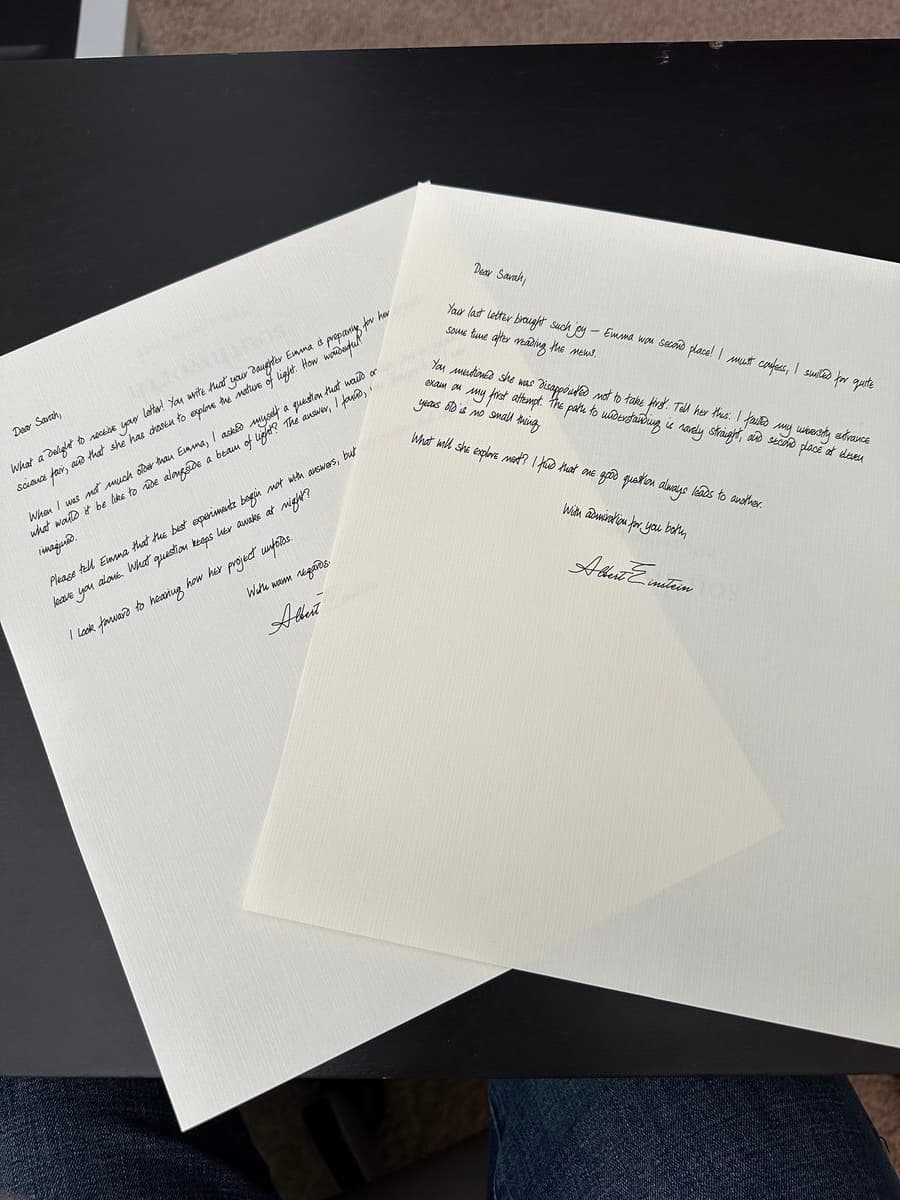
Every letter stands on its own.
No callbacks that assume the resident recalls the last letter. Each one is complete in itself, anchored in long-term memory: childhood, occupation, the music and machines of their era. The places memory tends to stay strongest are the places the letter goes.
Large print, built as a prompt.
Memory care letters come in large-print format, written so a staff member or visiting family member can read them aloud. Each one doubles as a ready-made one-to-one reminiscence activity. The figure asks, the resident answers, somebody listens.
Staff or family reply on the resident's behalf.
A resident doesn't need to hold a pen to be in the conversation. Whoever sat with her can jot or photograph what she said, and her pen pal answers it. The correspondence belongs to her either way.
A monthly digest email for the family.
Because the resident can't always relay what came in the mail, we do. Each month, family receives a short note about the exchange. "Einstein asked Dorothy about her teaching years. She told him about the one-room schoolhouse." Now Sunday's visit has somewhere to start.
Memory care program: $25 per resident per month. Everything in the core program, plus all of the above.
Pricing
Less than one bouquet per resident.
Free pilot month
Five residents. The full experience: intake, Pen Pal Day box, replies answered. No card, no contract, no obligation. We're confident the residents will settle the question for you.
Core program
$20 per resident per month
(8-resident minimum)
Every resident gets a letter every month, guaranteed, whether or not they write back. Every reply they send gets a personal answer in the mail within about a week. Includes the reply kit, mail-call materials, and a program certificate for your community.
Memory care
$25 per resident per month
Everything in the core program, plus self-contained letters anchored in long-term memory, large-print prompt-style materials, staff-mediated replies, and the monthly family digest email.
Pay for the year, get two months free. Built to match your budget cycle.
A typical community enrolls 10 to 12 residents, which comes to $200 to $240 a month. That's about what one visiting performer charges for a single afternoon. This is a month of programming: a synchronized community event, personal mail for every resident in between, and every reply answered. Per resident, it's $20 a month. Less than one bouquet, and it writes back.
Many communities pass the program through to family accounts as a $20 monthly enrichment line item. We'll send a one-page family explainer if that's your route.
FAQ
Is this AI? Who actually writes the letters?↓
Fair question, and I'd rather answer it straight than have you wonder. The words are composed in each figure's documented voice and personally reviewed before anything ships. I read what goes out the door with my name behind it. And the ink, the paper, and the mail are completely real: each letter is written in pen on premium paper, sealed, and posted. What your resident holds is not a printout. It's a letter.
Some of our residents can't write back. Does the program still work for them?↓
Yes, and this matters to us. The monthly letter arrives no matter what; nobody's mail depends on their ability to reply. If a resident wants to respond but can't write, a staff member or family member can reply for them in a sentence or two. And in memory care, the letter itself is the activity: a prompt to read aloud and talk over, whether or not anything gets sent back.
What information do you collect about residents? Who sees it?↓
Almost nothing, and nobody. Intake is a first name, hometown or era details, former occupation, and interests, provided by family or staff. Nothing clinical, no birthdates, no health information, ever. Letters are addressed to the resident at your community's address. We don't share or sell anything, and when a resident leaves the program, their details go with them.
How do replies physically work?↓
Two streams. The resident writes their reply on the included sheet or any paper they like. Staff photographs it with a phone (there's a simple upload link on the reply card; it takes about ten seconds). The answer comes back as a normal stamped envelope in your regular daily mail, within about a week. One smoothing rule: a reply sent in the last stretch of the month gets answered in the next Pen Pal Day letter instead, so nobody gets two letters two days apart.
What happens month to month?↓
The conversation continues. Each month's Pen Pal Day box arrives the same week, every enrolled resident included. Figures pick up wherever the correspondence left off: answering replies for residents who wrote, writing onward for residents who didn't. You can add a new resident anytime; they join the next box. You can pause or remove a resident just as easily.
What if we need to cancel?↓
Email me and it stops. Month to month, no contract, no term, no cancellation fee. Anything already written for the current cycle still ships, because the residents are expecting it. And the free pilot simply ends on its own unless you tell us to keep going. You'll never be auto-enrolled into anything.
Request your free pilot month
Five residents, one month, the full experience. I reply to every request personally, within one business day.
Here for one person, not a whole community?
If you're a son or daughter who found this page looking for something for your mom or dad, we have you covered too. Our gift correspondence is five real exchanges with the figure of their choice, written in pen and mailed to their door, for $29. You'll get a printable certificate to hand them today, and their first letter ships within two days. If their community might love the full program, forward this page to the activity director; that's how most of our pilots start.
Send a Pen Pal as a Gift →One box. One day. Everyone included.
Five residents. One month. No card, no contract.
Cited research concerns general categories of activity and social connection; it does not evaluate or endorse Historical Pen Pals.
Pinquart and Forstmeier, Aging and Mental Health, 2012; Woods et al., Cochrane Review, 2018; National Institute on Aging, via NIH MedlinePlus Magazine; National Academies of Sciences, Engineering, and Medicine, 2020.